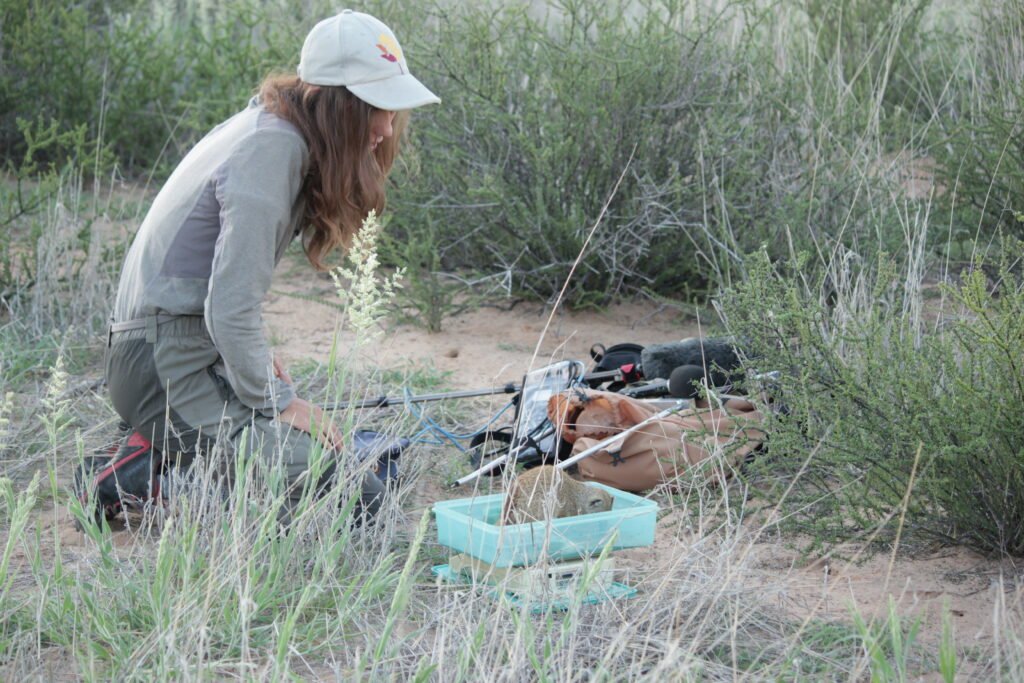
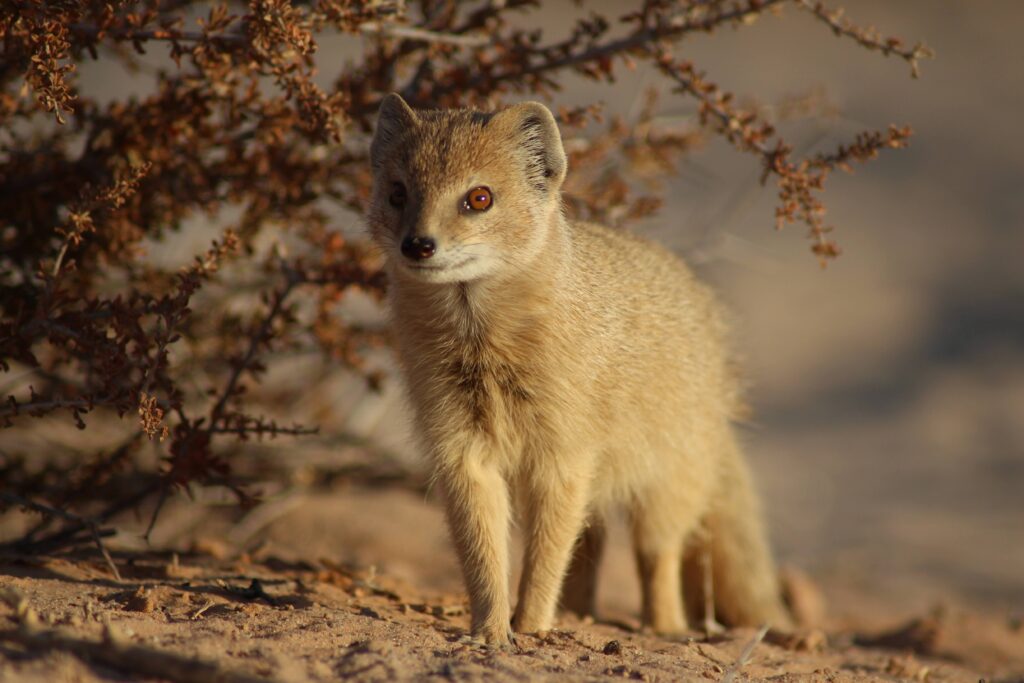
Launched in 2022, the Yellow Mongoose Project (YMP) is the youngest research project at the Kalahari Research Centre. Its primary aim is to understand these fascinating, desert-dwelling mammals, which are facultatively social. They live in small family groups, sharing burrow systems at night and early morning, but forage primarily solitary during the day. Our close observations of individually marked mongooses enable us to explore research questions that are often difficult to investigate in the wild.
Communication Research
Main Research Questions
Our research on vocal communication focuses on vocal ontogeny, call repertoire formation, alarm calls, and the social influences on vocalizations. Data collection methods include audio recordings, audio collars, microphone recordings and playback experiments, allowing us to study the communication systems of yellow mongooses across all age categories.
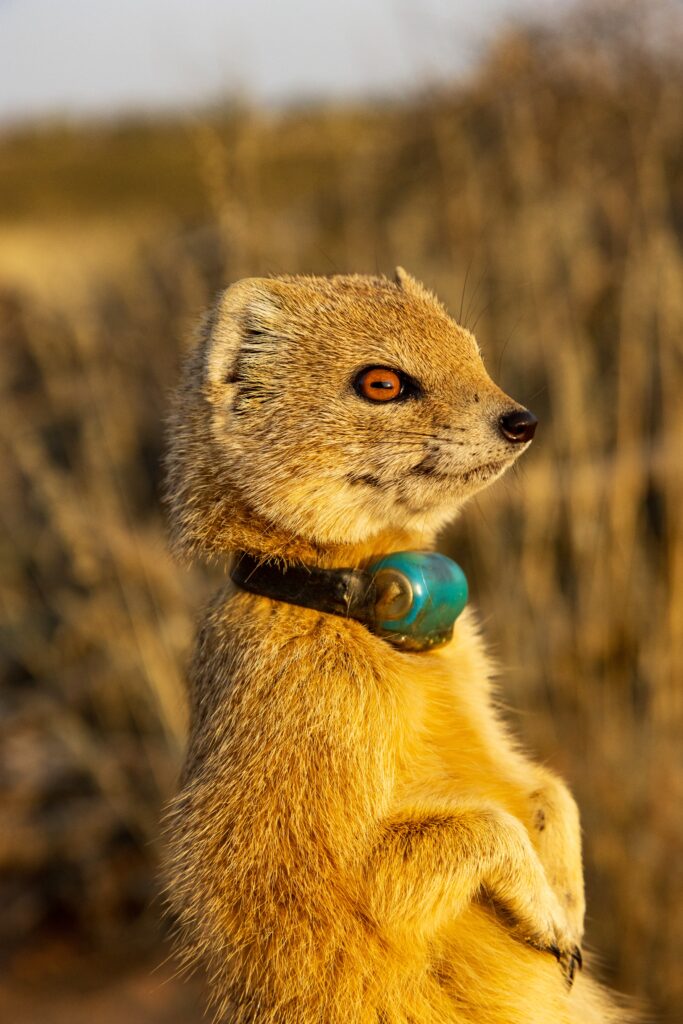
Due to our regular visits and individual tracking, we have achieved a high level of habituation in our population. This enables us to gather behaviour, life history and sound data from a young age. Pups are recorded as they emerge from their burrow, while older individuals are monitored with directional microphones during social interactions.
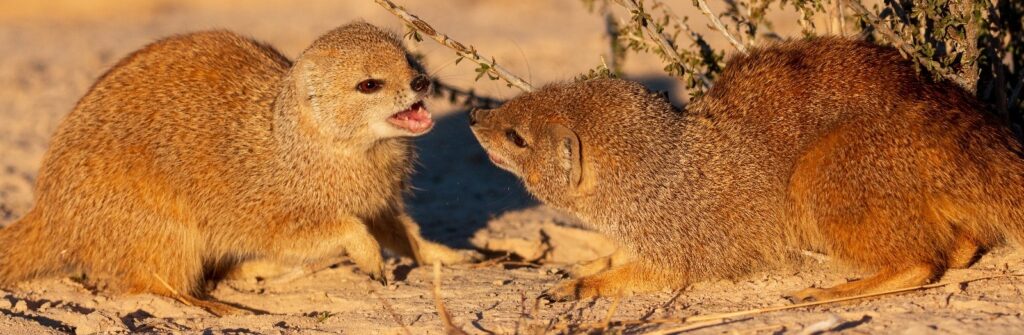
Both male and female yellow mongooses care for their offspring, engaging in babysitting and pup feeding behaviours. Their social interactions involve a range of vocalisations—affiliative, neutral, or aggressive—depending on the context. Alarm calls are also emitted when group members are present and a potential predator is detected. Despite these observations, much remains unknown about their communication system, prompting our investigation into the evolution of yellow mongoose vocalisations.
Findings so far
Yellow mongoose pups can produce over 10 call types within their first three months of life. Notably, they replace their vocal repertoire as they mature, shifting from pup-specific calls to those associated with adults upon reaching juvenile status. Ongoing research aims to further explore the evolution, development and complexity of their communication system.
Cognition Research
The mongoose cognition project broadens the research aim – uncovering sources of individual variation in cognition wild mammals, by researching not only cognitive development in meerkats but also in the sympatric and facultative social yellow mongoose found in the Kalahari region. The project aims at quantifying socio-ecological influences on cognitive skill development.
How does different social systems and social fluctuations impact skill learning and cognitive traits?
In previous research we assessed explorative behaviours in mongooses through both an intra and interspecific view. We there showed that meerkats use multiple senses when gathering information about something novel, including visual, touch, and olfactory cues and that the kinds of cues emitted by novel stimulus thus affect their exploration behaviour. Between species analysis showed that yellow mongooses, a less social mongoose than meerkats, showed higher levels of novelty exploration, when tested within the same habitat. (Birchmeier & Johnson-Ulrich et al. 2023).
Beyond Communication and Cognition
Due to our standardised data collection and continuous individual tracking, the scope of the Yellow Mongoose Project extends well beyond our primary focus on vocal communication. Our data collection approach enables us to gather a wide array of behavioural, physiological, and ecological data alongside our acoustic recordings. Consequently, the project functions as a highly versatile field platform that offers multiple opportunities for broader interdisciplinary research. Since its inception, our high-resolution dataset has successfully supported numerous independent projects and academic theses across various disciplines, — such as physiology, microbiome dynamics, predator-prey interactions, behavioural plasticity, activity shifts, and conservation ecology — allowing collaborating researchers and students to leverage our habituated population to explore a diverse range of evolutionary and ecological questions.